
Keyhole Bunion Surgery
- 17 April 2021
- Posted by: invicta_ortho
- Category: Foot and ankle

Keyhole Bunion Surgery – How modern surgical techniques have revolutionised the treatment of bunions
Why do people develop bunions (also known as hallux valgus)
Bunions can affect a range of different people from childhood through to our later years. There is a common belief that they are a hereditary condition but I believe they are the result of muscle imbalances within the foot cause by wearing shoes. In societies where shoes aren’t worn bunions are very rare and are probably due to a failure of proper development in the feet.
If you look at your hand, which until fairly recently in our evolution were feet, there are lots of plump areas. These plump bits are muscles within the hand that provide the power for fine control of the fingers. The more powerful muscles are too big to be in the hand and instead are found in the forearm with tendons running into the hand to control the fingers. The same basic anatomy is also present in the foot, however because of modern living we hardly ever use these small foot muscles. We spend most of the day in shoes and walk on floors that have been made perfectly flat and level. Were we to live as our ancestors did we would need our foot muscles to cope with uneven, slippery surfaces and to help us grip when climbing rocks or trees. The lack of use leads to muscle weakness and an imbalance between opposing muscle groups.
In addition to muscle imbalances within the foot, there are often imbalances in the power muscles of the lower leg. The calf muscles stay strong as they help to propel us forward or to reach up on to tip toes. The muscles at the front of the leg however are rarely used as artificially flat floors mean we don’t need to lift our feet to step over objects in our path.
This imbalance leads to the achilles acting like a powerful spring, lifting the heel into the air and forcing the front part of the foot into the ground. This overload of the front part of the foot is probably a contributing factor in the majority of foot conditions we see in the clinic.
So what can we do to avoid getting bunions?
Unfortunately walking barefoot isn’t very practical in the modern world! Simply keeping active and stretching the calf muscles are the best way to avoid developing bunions.
What if I already have a bunion?
Once the deformity is present the only options are to accommodate the deformity in wide-fitting comfortable shoes or have surgery to correct the foot shape. There are lots of splints and insoles on the market but they haven’t been shown to be effective for bunions.
Many people wrongly believe that bunion surgery is ineffective or very painful. With the latest keyhole surgery techniques this is no longer true.
What does the surgery involve?
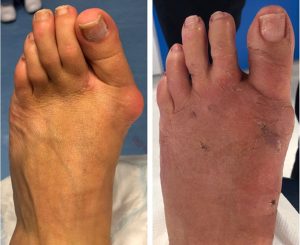
The old fashioned approach to bunion surgery involved a large incision along the inner aspect of the big toe with bone cuts and soft tissue surgery to correct the foot shape. This often required people to go into a cast or an uncomfortable heel weight bearing shoe. Surgery was often very painful and could result in an ugly scar and a stiff big toe.
The latest advance in bunion surgery is to correct the toe through a keyhole procedure. Patients can walk on the foot straight after surgery, although they should use a flat post-operative shoe for about 6 weeks to help bone healing. Keyhole bunion surgery leaves almost no scars and reduces damage to the soft tissues leaving patients with toes that are straight and maintain good movement.
Only a small number of surgeons in the UK are capable of performing keyhole bunion surgery. Mr Freeman is an expert in keyhole foot surgery and regularly teaches his skills to other surgeons from around the world. Mr Freeman routinely performs keyhole bunion surgery and, unlike most other surgeons is able to use these modern techniques for almost all foot and ankle procedures. This allows his patients to fully weight bear straight after surgery and without the need for cumbersome plaster casts.
How do I get more information?
For more information about keyhole bunion surgery in Tunbridge Wells contact (insert Invicta contact and my secretary details)
Richard Freeman MB BS, BSc, MSc, FRCS (Tr. & Orth.) is a Consultant Orthopaedic Surgeon who operates at both the Spire and the Nuffield Hospitals in Tunbridge Wells, as well as the Nuffield in Haywards Heath and the Spire at Gatwick Park. His NHS practice is at the Maidstone & Tunbridge Wells NHS Trust. See his 5 star feedback at iwantgreatcare.org


Mr Richard Freeman

MBBS, BSc (Hons), MSc, FRCS (Tr. & Orth.)